
Did You Know?

“The series of nine windows on the South Wall of the Sanctuary, from the Bema proceeding to the rear, deals with Israel’s great leaders, teachers, prophets, and poets whose inspiring influence and achievements have guided and strengthened Jews in every generation.”
Excerpt from the official Dedication Week program for Temple Emanuel, April 29-May 6, 1962.

WINDOW 1
Abraham-Israel’s Pioneer Monotheist
Multi-colored shapes and forms at the bottom suggest the idols which Abraham smashed in his father’s house. The burst of sunlight at the top represents the brilliant revelation of one Supreme God, Ruler of the Universe.
WINDOW 2
Moses-Israel’s Immortal Law Giver, Prophet, Teacher, Leader
Moses’ attempt to bring the law down to the children of Israel twice is suggested by the broken vertical purple lines in the center of the window indicating the two different Tablets of the Law. The spherical eye-shape at the top of the window suggests the frustrated attempt of Moses to enter the Promised Land with the result that he was only able to see it from afar.
WINDOW 3
David
The military leadership of Israel’s royal poet-warrior is symbolized by a golden shield at the top. The two vertical brown shafts below suggest musical lutes which David, according to tradition, played while composing the immortal psalms.
WINDOW 4
Solomon
Royal builder of the first Temple in Jerusalem, symbolized by the small green chapel in the top panel. Directly below is a representation of a green hooded High Priest robed for the ritual of the Temple Service.
WINDOW 5
Isaiah
Ancient Israel’s sixth century prophet, whose glorious vision of universal peace for all mankind still glows in the hearts of men today. This dream is suggested by the implements of warfare shattered and tumbling down the window and the golden vertical lines reaching upwards at the top towards the sunlight of peace.
WINDOW 6
Ezra the Scribe
Israel’s great post-exilic leader who was responsible for re-constructing religious and cultural life. The purple forms at the bottom suggest the broken stones of the Temple which were rebuilt. The quill point in the middle is symbolic of Ezra’s scribal profession. The elongated white Torah Scroll at the top is symbolic of the Mosaic Law which our ancestors under Ezra’s leadership swore to observe faithfully.
WINDOW 7
Rabbi Hillel
Famous Rabbinic Sage of the first century, whose classic Golden Rule, suggested by the warn bright holden hues, still inspires our moral actions today: “Do not do unto others what you would not want others to do unto you.”
WINDOW 8
Moses Maimonides
Israel’s great medieval physician, author, and philosopher. These three unique careers combined in his lifetime are suggested by a modernistic medical caduceus symbol in the bottom panel and the writer’s quill point in the middle. The vertical green lines striving upwards at the top suggests the philosopher’s eternal searching after the Torah.
WINDOW 9
Rabbi Isaac Mayer Wise
Found Father and Building of American Reform Judaism
The burst of yellow color at the top suggests the flowering of liberal Judaism in our century. The vertical golden lines running down to the bottom suggests that this liberal spirit of Judaism has its roots stuck deep within the traditional Jewish past.
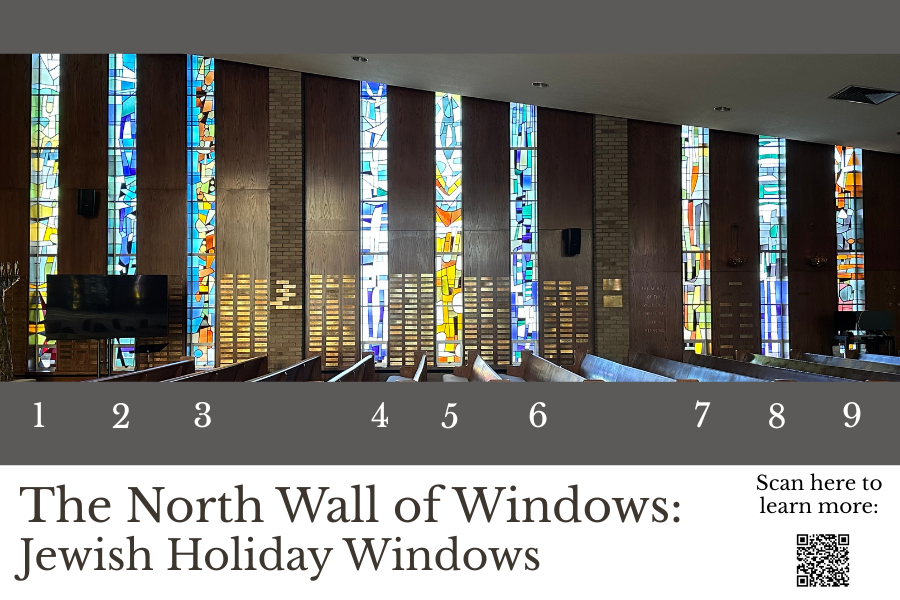
Excerpt from the official Dedication Week program for Temple Emanuel, April 29-May 6, 1962:
WINDOW 1
Rosh Hashanah
The despair of the year ending is depicted by the dark red colors in the bottom panels with the orange, blue, and green colors becoming progressively brighter and more confident as they reach up to the pure white at the top symbolizing faith and hope in the future. The third and fourth panels contain representations of the ram’s horn (the Shofar), symbolizing the historic call to worship and conscience.
WINDOW 2
Yom Kippur
The deep, brooding, inner turmoil surrounding Judaism’s solemn twenty-four-hour period of fasting and soul searching is suggested by the somber and meditative purple, blue, and grey colors characterizing the soul striving to fain communion with God.
WINDOW 3
Sukkot
The joy of the harvest season is colorfully and brightly depicted by a massive chain-like garland of gaily colored fruits and vegetables against a blue sky inspiring us to give thanks to God–The Eternal Provider.
WINDOW 4
Simchat Torah
Blue and white colors have traditionally represented God, the Guiding Spirit inherent in Jewish law. Blue depicts the heavens, and white symbolizes the shining purity and holiness of God.
WINDOW 5
Chanukah
The rekindling of the lights in the ancient Temple in Jerusalem following the Maccabean triumph over pagan Greece is depicted by brilliant shafts of orange and yellow vertical colors representing the traditional eight lights of Chanukah glowing in the home.
WINDOW 6
Purim
The persecution and martyrdom suffered by the Jews at the hands of tyrants down through the centuries is suggested by the harsh, stabbing shafts of dark and ominous purple, black and green colors pointed upwards, striving for release.
WINDOW 7
Passover
The deliverance from the slavery of ancient Egypt in the springtime of the year is suggested by a riot of joyous and warm colors of the season.
WINDOW 8
Shavuot
The long vertical blue and white lines reaching upwards represent the craggy cliffs of Mt. Sinai. The ten horizontal clear and white panes atop symbolize the Ten Commandments.
WINDOW 9
Shabbat
The trio of horizontal bars of brilliant orange symbolize the three historic purposes of the Jewish Sabbath–rest, worship, and renewal. The burse of white at the top depicts a shining crown traditionally worn by the Sabbath Queen.

The stained glass in the sanctuary was designed and created by French stained glass and dalle de verre artist, Robert Pinart (1927-2017), whose career spanned from the 1940s through 2008.
Pinart is known for his “bold abstract expressionist style and for his mastery of stained glass coloring and painting.” After Pinart immigrated to the United States in 1951, he was one of the first artists to use the dalle de verre techniques here.
He worked with numerous well-known glass studios, with synagogues, churches, and related organizations forming a major component of his portfolio of work, and even worked with renowned American architect Percival Goodman, who designed Temple Emanuel.
In 1993, Pinart received the first Lifetime Achievement Award from the Stained Glass Association of America. Over the course of his career, Pinart designed, stained, and produced dalle de verre glass windows for over 140 institutions and private residences throughout the country. He retired in 2008 and passed away in 2017.

- Did you know that the large, yellow and blue stained glass in our sanctuary displays an abstract “hey,” the first Hebrew letter in Hineh Mah Tov? In the bottom corner of the windows, the entirety of Hineh Mah Tov is written in both Hebrew and English, a reminder of Temple’s founding families’ goal to create a spiritual home where the South Hills Jewish community can appreciate how sweet and good it is to be together.
- When those first founding families began building Temple Emanuel’s facility, the project proposal included a simple decorative design using large swaths of yellow and blue colored glass panes in the sanctuary and lobby. Temple’s Board President at the time, Irving Isaacs, envisioned instead a more beautiful and elaborate display of storytelling in stained glass. To make his vision a reality, families purchased the panes, honoring loved ones whose names you can read in the lower corners of the stained glass today